Bema Seat Anxiety
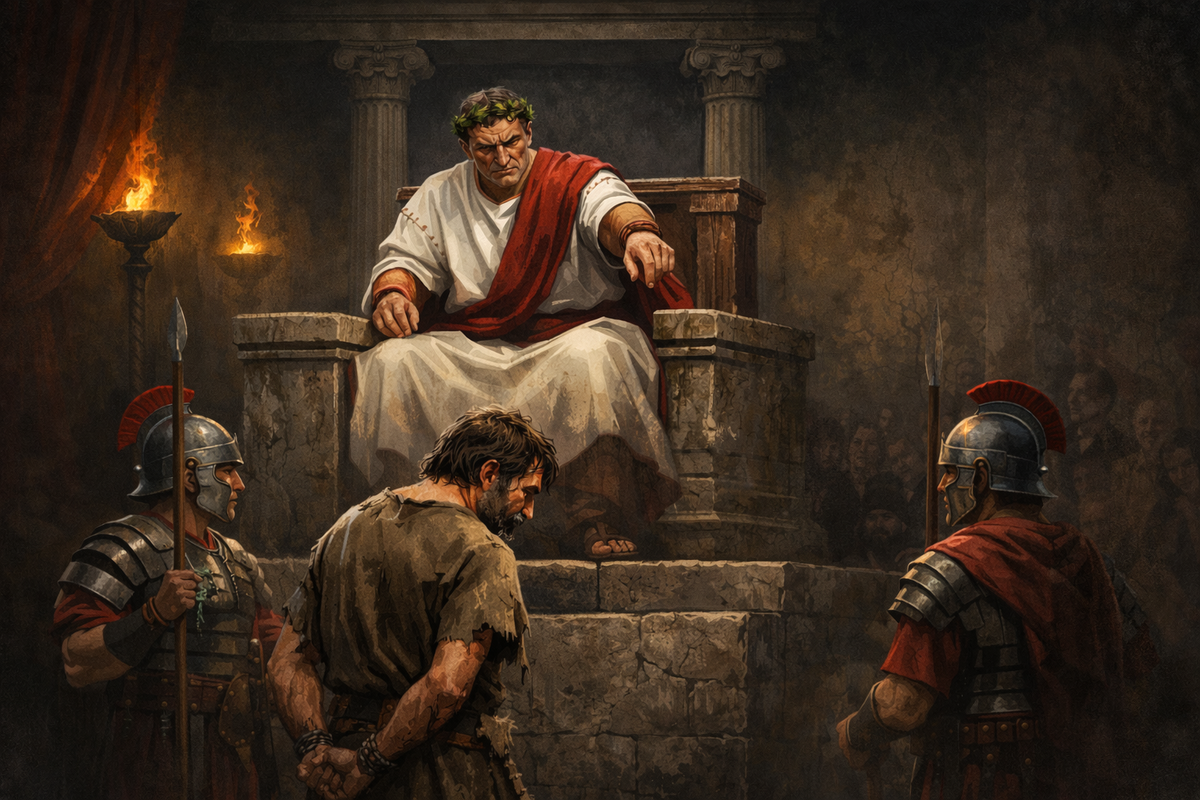
When Grace Becomes a Performance Review
I remember listening to a Christian radio station in the former Panama Canal Zone in the 1970s and early 1980s when I was a young boy. I can never forget the series by Pacific Garden Mission, Unshackled, which told real-life stories of people who came to Christ. There was also the Through the Bible radio program by J. Vernon McGee, in which he taught through the entire Bible verse by verse. I still have fond memories of hearing that Southern voice faithfully expounding the Word.
Christian radio has largely faded in importance today, as the internet has taken its place. Yet I treasure those early formative years, for they gave me exposure to reading through the whole Bible. Over time, however, I began to recognize certain theological assumptions that were simply part of the evangelical air of that era. McGee’s reach through radio far exceeded what the early Reformers were ever able to achieve, and like all teachers who labor within a particular moment in history, his ministry reflected both great strengths and real limitations. That does not diminish the good that was done, but it does remind us that no ministry is without need of ongoing reexamination in the light of Scripture.
One teaching I can never forget was the teaching of the Judgment Seat of Christ — the Bema Seat. It was taught by J. Vernon McGee when he was expounding 2 Corinthians 5:10.
“For we must all appear before the judgment seat of Christ, so that each one may receive what is due for what he has done in the body, whether good or evil.”
His comment was:
At the judgment seat of Christ only believers will appear. It is not a judgment of the believer’s sins, which Christ fully atoned for on the Cross. The judgment is to see whether you are going to receive a reward or not.[i]
It was always framed this way: Saved by grace — but rewards are by works. It is what is due for what we do in the body — good or bad.
Incentive for Obedience
This seemed to be a powerful incentive to try harder to please the Lord — or else lose your rewards or not have any. When this verse was paired with 1 John 2:28, the pressure only increased:
“And now, little children, abide in Him, so that when He appears we may have confidence and not shrink from Him in shame at His coming.”
Then the circle was complete. Work hard to gain reward — or suffer shame for lack of performance. The bema had become a performance review or final exam. Over time this seemed to undermine grace altogether. It was believe first — and then work. Work to rise higher in heaven or be ashamed for not working hard enough. This produced the proverbial works treadmill: work harder → fail → work harder → fail.
How is this any different than the medieval church Luther rebelled against? Where is the grace of God? Luther found his answer in Romans: “The just shall live by faith.”
Surely God cannot be merely a more powerful version of George Orwell’s Big Brother. His kingdom does not function on fear, exposure, and surveillance. Yes, fear can make a person obey — but it is the obedience of a slave, not a son. God calls us out of darkness and into the light. We are adopted sons — not slaves. If obedience is by fear--it is no longer by grace.
Context Is Everything
Context matters — and the context of 2 Corinthians 5 is often ignored. Paul is not describing a courtroom scene. He is speaking about our heavenly dwelling and our longing to be there. “For in this tent we groan, longing to put on our heavenly dwelling…” (v.2) We are told that God has given us the Spirit as a guarantee of our future heavenly bliss (v.5). This guarantee produces something very specific — courage. Paul says it twice. In v. 6, “So we are always of good courage” and in v.8 “Yes, we are of good courage.”
Courage can only come from confidence and confidence is a compound word in Latin meaning “with faith.” It is confidence in God’s promises and His goodness toward us. All of this comes before Paul ever mentions the bema seat. Which means the bema cannot suddenly become a place of terror, anxiety, or shame. The bema is not introduced as a threat. It is introduced in the atmosphere of hope, confidence, and longing.
What Is the Bema?
Nothing in the context suggests a courtroom or criminal trial. The word bemasimply means a raised platform. In Roman usage, it could serve several functions:
1. A place of trial
2. A place of honor and reward
3. A place of public announcement
If we assume the bema must mean only a trial, we collapse all meaning into one register: judgment. But if it is some kind of judgment — what is the verdict? Christ has taken away our sin. “There is therefore now no condemnation for those who are in Christ Jesus.” Amen and amen.
So, when Paul says: “each one must receive what is due for what he has done… whether good or evil,” we must ask the question honestly: What is due? The verdict concerning our sins is already settled.
The blood of Christ cleanses all sin. We can never be guilty again. David is not guilty of the sin with Bathsheba — and at the bema, this case will not be reopened. It will be publicly acknowledged that he is not guilty.
So then — what about the good we do?
“Well, done, good and faithful servant”
This too will be publicly acknowledged. The bema is not a place where God evaluates our independent performance. It is a place of verdict and public acknowledgment before the heavenly hosts of God’s work of redemption in us.
It is His work — not ours. We cannot atone for our sins. He does. We cannot do anything truly good apart from Him.
“Apart from Me you can do nothing.” (John 15)
At the bema, God publicly declares and crowns His works of grace in us. It is not that we do not do good works, but the origin is from Him. If there is anything good in me, you can be sure God put it there. There are no autonomous works—only Spirit wrought works of grace. These are the works He crowns.
If this is the verdict, then there is no need to fear or have anxiety. It is a vindication. The bema is the public unveiling of God’s grace. Christ has won the victory — and because we are united to Him, we have won as well. His victory is our victory by His grace.
A Table, not a Tribunal
This reading fits the context perfectly. The bema is not a place we need to dread — it is a place we long to be. We are told we may approach the throne of grace with confidence because we have been redeemed (Hebrews 4:16). If we think of the bema less as a courtroom and more as a table or a family dais, everything changes. It is a place where our Father welcomes us. Commends us. Shares a meal of fellowship with us and with all the redeemed. Seen this way, the bema is not a trial. It is a place of honor. A public vindication. A celebration meal. That is the proper register. It is a place of rest not anxiety.
Conclusion
The image of the bema seat as a performance review — an audit of my Christian life — haunted me for years. Did I do enough? Is God pleased with me? Should I try harder so I can earn more reward? All of this ultimately undermines the gospel. Grace means I receive what I do not deserve.
All is of grace.
Sadly, this teaching is not merely a relic of the past. A quick look at modern YouTube preaching on 2 Corinthians 5:10 confirms that bema seat anxiety preaching is alive and well. If you suffer under it — be of good cheer. Our Lord has overcome. He has won the victory for us — so that we may never live in shame or guilt but be free to serve Him joyfully.
Personal Note
I will say that McGee’s overall teaching was not big on bema seat obedience preaching. It was there, just not at the center. Given the reach of his program around the world, it means that many people hold to some version of the bemarewards scheme. The problem is that this system undermines free grace and introduces works as a part of our heavenly standing. It matters not that the works are not saving you, but they are often presented in such a way to rank Christians into definable groups—the super saints, the mediocre saints and those who are barely saved. This will always produce anxiety. It will also warp the gospel and your understanding of who God is.
I do not believe that the doctrine of rewards is merely an intramural debate. This is not simply one view among many. It strikes at the very fundamentals of the gospel. If works play any role in a heavenly ranking system, then the Solas of the Reformation are placed under strain. Salvation would no longer be sola gratia or solus Christus[ii]. Our works or efforts cannot form any part of our salvation[iii]. A “higher heaven” or “greater glory” is still the receiving of something by doing something. And if the doing itself is said to be by grace alone, then the question remains: why are there any rankings at all? It was His work. Augustine’s axiom therefore applies: God crowns His own works.[iv]
If the doctrine of rewards is taught crassly as your efforts, then Galatians says this is another gospel. Galatians 3:2
Let me ask you only this: Did you receive the Spirit by works of the law or by hearing with faith? Are you so foolish? Having begun by the Spirit, are you now being perfected by the flesh?
This passage teaches that we are saved by faith alone. If you begin by faith you cannot finish by works. If the word “saved” is divided into levels of heaven and Christ gets you in and you get yourself up by your effort—it is just the old merit economy of salvation of the Medieval church relocated to heaven.
The Bema is an Incentive to Serve God
Knowing now what the context of the bema seat is, I find it to be a great comfort and not a trial. It really is a family homecoming. God shows the whole host of heaven--this is my son or daughter. There is no fault in him or her and look at his or her works of love. He is boasting of His work in and for us. It really is Soli Deo Gloria.
Does this motivate me to serve Him more? Yes! Paul says as much in the immediate context. 2 Cor 5:9
So whether we are at home or away, we make it our aim to please him.
We want to please Him not to gain anything other than to please Him. We are not seeking status or an increase in sonship. Sonship is not scalable. We do not earn our sonship. It was given to us. All is of grace as it says in Romans 11:6, “But if it is by grace, it is no longer on the basis of works; otherwise, grace would no longer be grace.” If working gets greater glory--then sola gratia is not true. May that never be!
This is a Return to the Galatian Error
Paul’s letter to the Galatians exposes the danger of adding anything to the gospel after Christ. The error he confronts is not the denial of grace at conversion, but the reintroduction of law afterward. “Having begun by the Spirit,” Paul asks, “are you now being perfected by the flesh?” (Gal. 3:3).
That question cuts to the heart of the issue. The Galatian problem was not that believers denied faith, but that they believed growth, maturity, and fullness came through added performance. Grace was treated as the entrance requirement, while progress toward fullness was governed by effort.
This is why Paul speaks so sharply. To add works after the cross is not a minor mistake—it is a different gospel. The law does not save—it only reveals. When it is made the measure of advancement, it becomes a new form of bondage. “For freedom Christ has set us free,” Paul declares; “stand firm therefore, and do not submit again to a yoke of slavery” (Gal. 5:1).
The gospel does not merely free us from condemnation; it frees us from confidence in ourselves. Paul’s rebuke in Galatia was not directed at obedience, but at trust misplaced. The error was not that believers acted, but that they began to regard their acting as something added to Christ. What was received as gift was quietly transformed into achievement. Any system that teaches believers to begin by grace yet advance by themselves — whether on earth or in heaven — repeats the Galatian error, not by denying grace in word, but by displacing it in practice. [Nota Bene]
[i] McGee, J. V. (1991). Thru the Bible commentary: The Epistles (2 Corinthians)(electronic ed., Vol. 45, p. 62). Thomas Nelson.
[ii] The Reformation’s five solas were not abstract slogans but grammatical boundaries guarding the gospel itself. Sola Scriptura affirmed Scripture as the only infallible norm of faith, not the denial of tradition but its subordination. Sola Fideconfessed that sinners are justified by faith alone, apart from works, not because faith is a work, but because it receives Christ. Sola Gratia declared salvation to be entirely God’s gift, excluding all merit, preparation, or cooperation as its cause. Solus Christus proclaimed Christ alone as mediator, priest, and righteousness, leaving no remainder to saints, sacraments, or spiritual ladders. And Soli Deo Gloria located the end of redemption not in human improvement or spiritual achievement, but in the glory of God alone—who crowns His own gifts in His people.
[iii] Philippians 2:12 is often cited to support a synergistic view of sanctification: “work out your own salvation with fear and trembling.” Read in isolation, the verse can appear to place the decisive emphasis on human effort. However, Paul immediately grounds this exhortation in divine agency: “for it is God who works in you, both to will and to work for his good pleasure” (Phil. 2:13). The believer’s activity is therefore not autonomous cooperation alongside God, but the outworking of God’s prior and present working within. The source, power, and efficacy of sanctification remain wholly of grace. The command does not introduce a second causal agent, but calls the believer to live in conscious dependence upon the God who is already at work.
I do not pretend to fully comprehend this mystery any more than I can comprehend the divine inspiration of Scripture itself. The human authors truly wrote, yet they were not the ultimate source. So too the believer truly acts yet is not the originating cause. If we attempt to resolve this mystery philosophically, we inevitably fall into rationalism. Scripture does not invite us to solve the tension, but to confess both truths faithfully.
[iv] If it is argued that God, by sovereign grace, works greater obedience in some believers and then chooses to elevate those saints above others on that basis, the distinction would rest entirely in His sovereign will. Yet even on those terms, such a scheme would introduce a division within the body of Christ — a kind of elect within the elect. This would fracture the unity Scripture repeatedly ascribes to the body, in which all are equally members, equally adopted, and equally heirs in Christ. The theological implications of this question — particularly as they relate to unity, inheritance, and Christ’s prayer in John 17 — require fuller treatment than can be given here and will be taken up in a separate article.
[Nota Bene] None of this denies that the apostle Paul speaks of labor, striving, or obedience. He can say without hesitation, “I worked harder than any of them,” and yet immediately add, “though it was not I, but the grace of God that is with me” (1 Cor. 15:10). Scripture affirms both without embarrassment.
What it does not give us is the mechanism.
Paul does not explain how divine grace works through human willing, nor does he attempt to reduce it to a chain of causality. He simply confesses the reality: the believer truly acts, yet the source of the action is not the self. “It is no longer I who live,” he says, “but Christ who lives in me” (Gal. 2:20).
This is not a problem to be solved but a mystery to be confessed. When we attempt to analyze obedience down to its efficient causes, we inevitably fall into rationalism—either attributing too much to man or dissolving human action altogether. Scripture refuses both errors. It teaches real obedience without autonomous effort, real activity without self-originating power.
The Christian life, therefore, is not lived by explaining how grace works, but by trusting that it does. What appears to us as willing and working is, in truth, Christ working in us — a reality we receive, not a process we master.