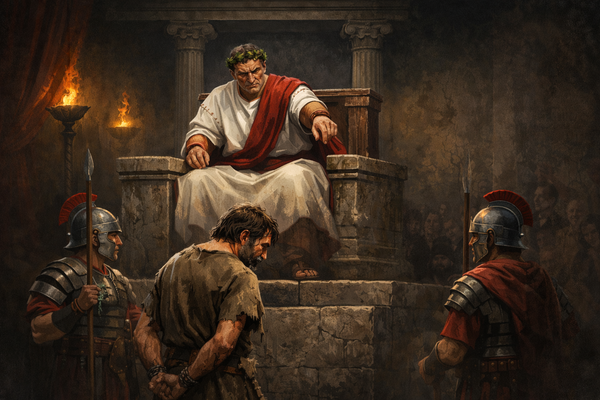
The First Shall be Last
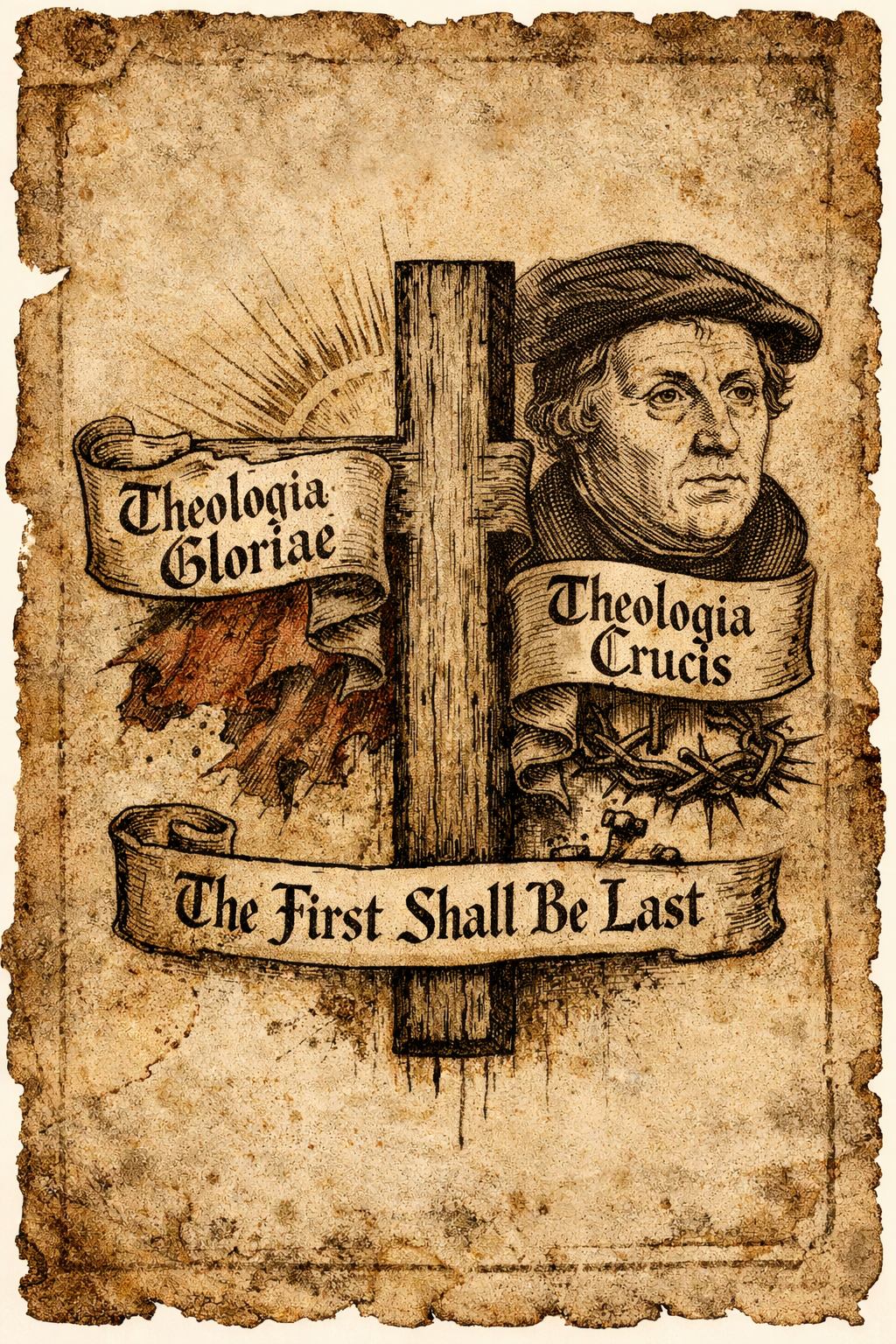
The Collapse of the Theology of Glory
Who wants to be last? Who wants to be first? When Jesus says the first shall be last and the last shall be first, is he giving us a formula on how to be first? One may be inclined to be last in order to be first—but is that really what Jesus was teaching? The juxtaposition of first and last at the end of the day means that however you make it to first you will still be last.
In Matthew 19:27-30 it says:
27 Then Peter said in reply, “See, we have left everything and followed you. What then will we have?” 28 Jesus said to them, “Truly, I say to you, in the new world, when the Son of Man will sit on his glorious throne, you who have followed me will also sit on twelve thrones, judging the twelve tribes of Israel. 29 And everyone who has left houses or brothers or sisters or father or mother or children or lands, for my name’s sake, will receive a hundredfoldand will inherit eternal life. 30 But many who are first will be last, and the last first.
Is our Lord teaching us how to be first or is He speaking in a parabolic manner? At first glance, He appears to be incentivizing service for the kingdom by the offer of rewards. Those who really serve will receive a hundredfold and will sit on twelve thrones judging the twelve tribes of Israel. Surely this is a great incentive, but then He says, “the first will be last.” This is a most unexpected conclusion, and it destroys the logic of incentivized obedience altogether.
Matthew’s Kingdom Discourse
Many Christians have indeed seen this passage as holy incentive for obedience and service. Why else would Jesus say it? If, however, we look at where this passage is in Matthew, we can begin to see a different interpretation take shape.
1. Disciples ask Jesus who is the greatest in the kingdom (Matt 18:1-4)
2. Let the children come to me (Matt 19:13-15)
3. The rich young ruler (Matt 19:16-22)
4. Rich people cannot easily enter the kingdom of heaven (Matt 19:23-26
5. Jesus’ teaching on the disciple’s hundredfold reward and twelve thrones (Matt 19:27-30)
6. Laborers in the vineyard (Matt 20:1-16)
7. Jesus foretells His death a third time (Matt 20:17-19)
8. A mother’s request for her sons to sit on the right and the left (Matt 20:20-28)
Taken together[1], nothing in this section resolves along ordinary lines of expectation. It reads as a sustained reversal narrative. The disciples ask about greatness, and Jesus points to children. The rich young ruler seeks a to-do list for securing a heavenly inheritance and is told instead “to sell everything, give to the poor and follow Me.” When asked who then can be saved, Jesus answers that it is impossible—only God can save. Jesus speaks of reward and then overturns the logic of rewards by declaring that the first will be last. The laborers who worked all day expect greater compensation but receive only a denarius. In the midst of these reversals, Jesus foretells His death, and finally a mother asks for positions of honor for her sons at His right and left hand. Jesus’ response is not to grant the request at all. He does not speak in terms of position or rank but redirects the question entirely. Instead of addressing seats of honor, He speaks of suffering and service. His answer overturns her assumptions about the kingdom. At every point, expected outcomes are subverted. These reversals are not incidental to the passage—it is an explanation of what the kingdom of heaven is really like[2].
Theology of the Cross
One of the central problems the disciples struggled with was their desire to get ahead of one another. They argued about who would be greatest, who would receive honor in the coming kingdom, and who would sit at Christ’s right and left hand. This impulse did not arise from misunderstanding alone, but from the fallen condition of mankind itself. We are wired to seek glory.
This instinct did not disappear when they were born again either. It followed the disciples even as they walked with Christ. They expected the kingdom of God to arrive in visible power — a political deliverer, a restored throne, a Solomon 2.0 who would crush Rome and exalt Israel before the nations.
But God does not work the way fallen men expect.
Martin Luther described this fundamental conflict as the difference between the theology of glory and the theology of the cross. The theology of glory assumes that God reveals Himself through strength, success, progress, and visible triumph. The theology of the cross teaches the opposite: that God reveals Himself precisely where human reason would never look—in weakness, suffering, humiliation, and apparent defeat.
Luther referred to this paradoxical way of God’s working as the Deus absconditus—the hiddenness of God. We have the God revealed to us in Scripture, yet even there His ways are beyond our ways and His thoughts beyond ours. He works not as we might imagine or often wish, yet His work is perfect and always for His glory and our good.
God’s work of redemption itself came through the cross—not through display, not through conquest, not through recognition, but through shame and death. And God’s work in us follows the same pattern. What appears to be loss is often His instrument of healing. What looks like a setback is often His means of salvation.
He breaks us in order to heal us.
The Theology of Glory in Glory
Some suppose that the eternal glory of the saints in heaven will finally fulfill what the theologians of glory longed for all along — status, rank, and a hierarchy of rewards. On this view, the instincts of fallen humanity are not so much corrected as postponed. What could not be granted on earth is simply deferred until eternity.
In this scheme, some saints will shine brighter than others. Earthly sacrifice becomes heavenly advancement. Faithfulness here translates into greater position there. After all, did not Jesus promise a hundredfold return? Did he not speak of crowns, authority, and even thrones? The message, then, is subtle but powerful: get busy with the kingdom work, for it serves a dual purpose. It glorifies God — and it advances our own future blessedness. Obedience becomes a sanctified investment strategy. The language is pious, the motivation appears holy, and the incentive seems safely relocated to heaven.
Glory Rescheduled
Yet this way of thinking raises a serious question: has the theology of glory truly been crucified — or merely rescheduled? This way of thinking might attempt to legitimize itself by appealing to eschatology. It may be said that the theologians of glory merely suffered from an over-realized eschatology of glory — that their error was not the desire for status, rank, or distinction itself, but only its premature expectation. Glory, on this account, was sought too soon. What was improper on earth is made proper in heaven.
But this explanation does not resolve the problem; it conceals it. It treats the theology of glory as a timing mistake rather than a category error. The instinct itself is left untouched. It is not crucified but deferred. The cross is reduced to a scheduling correction.
Yet the theology of the cross does not merely teach that glory comes later. It teaches that glory is not what fallen man imagines it to be at all. The cross does not rebuke impatience; it judges the very instinct that seeks greatness through comparison, rank, or elevation over others — whether now or in eternity.
Soli Deo Gloria is therefore not a devotional slogan or pious refrain, but a theological verdict: all glory belongs to God alone, because all that is truly glorious flows from him, returns to him, and can never be claimed as our own. We reflect his glory as creatures redeemed by grace, but we never possess it as our own.
Merit not Here nor There
Luther’s great instinct was to destroy all merit at the foot of the cross. There, before Christ crucified, every claim of human merit collapses. Salvation cannot be earned, advanced, or secured by effort. It is given wholly by grace. In this sense, the theology of the cross stands as the death of merit in soteriology.
But if the cross is the central fact of our salvation, then it cannot be limited to the moment of conversion. God did not merely abolish merit up to the cross and then quietly reintroduce it beyond it. The cross does not function as a temporary clearinghouse before a merit economy resumes in glory.
If merit is destroyed by the cross, it is destroyed forever.
The same cross that cancels merit before God in this life also defines the shape of all glory in the life to come. Our future blessedness will not be the product of our accumulated effort, faithfully tallied and rewarded. Whatever work we do will be cross-bought, cross-given, and cross-shaped. It will never be detachable from Christ’s work and transferred into a personal spiritual account—otherwise salvation ceases to be by grace alone!
A consistent theology of the cross must therefore apply on both sides of Calvary — to the before and the after, to the left and to the right. It governs not only how we are brought into salvation, but how salvation itself is consummated. The cross does not merely open the kingdom; it defines the kingdom. If glory itself is cross-shaped, then the works that flow from faith cannot be treated as personal spiritual capital. In other words, the theology of the cross must govern both soteriology and eschatology.
He Works Through us
If all of our works are from Him, then how can we possible boast about anything? How can our works be the measure of our blessedness if they were given to us by God’s grace? We may do a good deed, but we are not the source of the good deed—God is.
Looking at the scriptures, we find that all of works are wrought by God’s grace.
Rom 3:27 Where is boasting then? It is excluded. By what law? of works? Nay: but by the law of faith.
1 Cor 4:7 What do you have that you did not receive? If then you received it, why do you boast as if you did not receive it?
John 15:5 “I am the vine; you are the branches. If you remain in me and I in you, you will bear much fruit; apart from me you can do nothing.
Augustine recognized this long before the Reformation:
God crowns our works as His gifts, emphasizing that any good we do is ultimately a result of His grace and mercy. Our new obedience can never function apart from His mercy to us in Christ.
Equality in the Body
Paul’s teaching about the body of Christ shows that although there are different parts of the body, there is no division into a hierarchy where one part is greater than the other.
Looking at parts of 1 Cor 12:12-31, it says:
12For just as the body is one and has many members, and all the members of the body, though many, are one body, so it is with Christ. 13For in one Spirit we were all baptized into one body—Jews or Greeks, slaves or free—and all were made to drink of one Spirit.
14For the body does not consist of one member but of many. 15If the foot should say, “Because I am not a hand, I do not belong to the body,” that would not make it any less a part of the body. 20As it is, there are many parts, yet one body.
But God has so composed the body, giving greater honor to the part that lacked it, 25that there may be no division in the body, but that the members may have the same care for one another.
27Now you are the body of Christ and individually members of it. 28And God has appointed in the church first apostles, second prophets, third teachers, then miracles, then gifts of healing, helping, administrating, and various kinds of tongues.29Are all apostles? Are all prophets? Are all teachers? Do all work miracles? 30Do all possess gifts of healing? Do all speak with tongues? Do all interpret? 31But earnestly desire the higher gifts.
If there is no division of the body on earth how can there be a division in heaven? One’s vocation or location in the body does not make one less or more—there is total equality because there is one body. In Matthew’s idiom all will receive a denarius because all are one in Christ.
That some jobs in the body seem unimportant, God gives greater honor so that will not be any jealousy. This, I believe, is part of God’s condescending grace to support the weakness of our flesh. We are one, but He lifts up those who seem to us to be weak, so that the body may not be torn apart by factions, boasting and pride. It appears here that God is precluding the theology of glory in His church.
If this is how God works on earth, how will it be in heaven? Will there be inequality in the body where some saints will have greater status in heaven? Will the apostles have separate thrones judging the twelve tribes of Israel? Jesus said this, but what did He mean? Was He teaching a sanctified theology of glory?
The Twelve Thrones
At this point we must slow down and give careful definition to the mediatorial kingdom of Christ. When eschatology is reduced to a simple binary—either the present church age or the final consummation—we lose an essential interpretive framework. Scripture’s kingdom texts are thereby flattened, and vital distinctions necessary for faithful exegesis disappear.
When Christ ascended into heaven this was the beginning of His Session at the right-hand of the Father. He is now seated on David’s throne as the God-Man thus fulfilling Daniel’s prophecy of the enthronement of the Son of Man. (Daniel 7:13-14) He commissioned the apostles to go into all nations as it says in Matthew:
Then Jesus came to them and said, “All authority in heaven and on earth has been given to me. Therefore go and make disciples of all nations, baptizing them in the name of the Father and of the Son and of the Holy Spirit, and teaching them to obey everything I have commanded you. And surely I am with you always, to the very end of the age.”
The twelve thrones are the vocations of the apostles in their respective earthlyministries[3]. God set the apostles as the foundation stones of His church. That was their place in the body, but in heaven there are not now acting as apostles nor are they sitting on twelve literal thrones. When the Bible speaks of judging, it is a proclamation of God’s truth. This is exactly what Christian ministry is—a proclamation. It can be both judicial and pedagogical.
The thrones then are not perches of prestige and honor so much as they are of service in the kingdom. Jesus taught the difference between the kingdoms of this world and His kingdom in His discourse with the mother of James and John. He who wants to be great must be servant of all.
The Whole Church Is Tasked with the Great Commission
Every member of the body has a place in the work of the ministry. There is a general office and a special office. All believers are prophets, priests, and kings in a general sense, yet God has also instituted special offices—such as pastors and teachers—to equip the whole body for the work of the ministry.
While pastors and teachers may exercise greater authority, they are not separate from the body. The general office of all believers is no less important than the special office of ordained ministry. Mothers, fathers, businessmen, and teachers all proclaim God’s truth within their respective callings. Honesty in business is a witness. Training children in the nurture and admonition of the Lord is a general calling of profound importance.
The prayers of Augustine’s mother Monica and her faithful instruction as a mother bore extraordinary fruit in the history of the church. In her intercession and vocation, she was “sitting on a throne” that God had given her as a mother. Her calling was no less important than Paul’s—only different.
This is not to deny the distinction between special and general office, only to make the point that both are necessary and equally important. You cannot have one without the other and we must have both.
Vocation, Not Ranks
If vocational differences do not produce rankings on earth, how can they produce rankings in heaven? To do so would be to construct a kind of reverse Dante’s Inferno—a tiered merit ladder in heaven. Dante did indeed write another book called Paradiso where he explicitly constructed the reverse of the Inferno. Heaven, however, is not a graded economy of reward. It is one undivided place of eternal, equal blessedness in Christ. No one can be more a son or daughter of God. Adoption knows of no degrees. Union with Christ is not scalable as if one Christian is more in Christ than anyone else.
What then do we make of Christ’s exhortation to His disciples that some who have left houses or brothers or sisters or father or mother or children or lands, for His name’s sake, will receive a hundredfold and will inherit eternal life?
The Hundredfold Reward
All our work is rewarded a hundredfold or with a “denarius” to use Matthew’s idiom. What is the denarius? It is Christ Himself. The Bible is written in an accommodated form to condescend to our weaknesses. Jesus is not literally promising a scalable rewards economy or perks for works. He has promised to give the reward of rewards—Christ! Saying a hundredfold is simply a way to express the greatness of the reward—not that some get two hundredfold and some get fiftyfold—we all get a denarius so to speak.
If we look at Christ’s reward, then we can begin to see that our reward is the mirror image:
Psalm 2:7-8 “Ask of me, and I will make the nations your heritage, and the ends of the earth your possession.”
Ephesians 1:18 having the eyes of your hearts enlightened, that you may know what is the hope to which he has called you, what are the riches of his glorious inheritance in the saints,
If Christ’s reward is His church—His bride, then is it so hard to see that our reward will be our Lord, Redeemer and Bridegroom?
Genesis 15:1 confirms this: Fear not, Abram, I am your shield; your very great reward.
How can anything be of greater value than Him. We in a sense all become Levites whose inheritance was the Lord Himself.
Deuteronomy 10:9 Therefore, Levi has no portion or inheritance with his brothers. The LORD is his inheritance, as the LORD your God said to him.
Having seen what the reward is, now let us look at what Jesus said to the mother of the sons of Zebedee.
Sitting at the Right Hand and the Left
When Jesus said,
“But to sit at my right hand and at my left is not mine to grant, but it is for those for whom it has been prepared by my Father,”
was He speaking literally?
Given how much of Jesus’ discourse in Matthew overturns ordinary expectations, it is unlikely that He was describing two literal seats in heaven. Daniel’s prophecy governs the grammar: the Son of Man sits at the right hand of the Ancient of Days. The New Testament consistently affirms that Christ alone sits at the Father’s right hand. There are not two additional chairs beside Him.
What then does Jesus mean by “for whom it has been prepared by my Father”?
Immediately Jesus speaks of drinking the cup and undergoing suffering. The language is not about rank, but about participation in His death. Matthew later seems to answer the question quietly:
“Then were there two thieves crucified with him, one on the right hand, and another on the left.” (Matt. 27:38)
This may appear at first to be a stretch, but within Matthew’s theology it fits perfectly. The Father had prepared the cross. The request for glory is answered with suffering. The right and left are not places of honor, but places of suffering. This is every Christian’s calling—we are called to suffer with Him. It is all the theology of the cross.
If you would be great in my kingdom, Jesus says, you must serve. You must take up your cross and follow me.
Conclusion
I am not a Lutheran, but I have been greatly helped by Luther’s teaching. His theology of the cross has been a much-needed correction in my life, and it continues to confront my inborn tendency toward glory. We all suffer from this.
Jesus’ teaching about the first and the last is not a way to become first by choosing to be last. His intention was far more radical: to destroy the entire raison d’être of ranking in the first place.
The kingdom does not rearrange the order of honor — it abolishes it.
Heaven is not what we imagine it to be. There are no ranks there. Our union with Christ is the grammar of our entire salvation. There is one throne and one inheritance. As Paul says in Ephesians, we are already seated with Him in the heavenly places.
For now, we live as pilgrims. We may occupy earthly “thrones” of service and vocation for a time, but they are temporary. One day, all distinctions will fall away, and we will be united together in Christ — reigning with Him on one throne.
Amen. Come, Lord Jesus.
[1] In my early training in biblical exegesis, we were taught not to begin with isolated verses, but with the structure and argument of the book as a whole. Before any analytic exegesis of a particular passage, we were required to construct a synthetic outline of the entire book, so that individual texts would be interpreted within the author’s larger discourse rather than in isolation. This approach shaped how I have learned to read extended narrative sections such as Matthew 18–20.
[2] A synthetic reading of Matthew shows that this section functions as extended kingdom instruction. Through parables, encounters, and interruptions, Jesus keeps answering the same question from different angles: What is the kingdom of heaven like? And the consistent answer is—not what you think. Every scene dismantles ordinary expectations of greatness, reward, and status.
[3] The twenty-four thrones in John’s Apocalypse should not be read as literal seats of individualized authority. Revelation is apocalyptic literature, communicating theological realities through symbolic imagery rather than architectural description. Scripture elsewhere makes clear that believers are already seated with Christ in the heavenly places (Eph. 2:6). The reign of Christ is not partitioned into countless personal thrones, as though glory were divided into individual allotments. Rather, believers reign in union with Christ, sharing in his one kingship. To multiply this imagery into millions of literal thrones misunderstands both the genre of Revelation and the doctrine of union with Christ. The imagery speaks not of ranked authority, but of shared participation in the one reign of the exalted Son.